
Luggage Bags for Every Indian TripOverview
Luggage bags are the suitcases, trolleys, duffels and backpacks people use to carry belongings while travelling. Indians travel in very different ways: a Mumbai-Delhi flight, an overnight train, a road trip to the hills or a family wedding. Each trip calls for different luggage bags. This guide matches bag types to the trips Indian travellers actually take.
Key Takeaways
- Indian domestic airlines carried 16.69 crore passengers in 2025, up 3.48% from 2024 (DGCA data via PTI).
- IMARC Group values the India luggage and suitcase market at about USD 4.0 billion in 2025 and projects USD 7.3 billion by 2034.
- On Indian flights, the BCAS one-hand-bag rule limits cabin baggage to one bag of up to 7 kg plus one personal item of up to 3 kg.
- IndiGo’s domestic economy check-in allowance is 15 kg, with a 23 kg cap on any single checked bag.
- A three-piece set of cabin, medium and backpack covers most Indian travel without buying a new bag for every trip.
What are the main types of luggage bags?
Direct answer: The main types of luggage bags are hard-shell suitcases, soft-shell suitcases, duffel bags, travel backpacks and garment bags. Hard and soft suitcases come as wheeled trolleys in cabin, medium and large sizes. Duffels and backpacks are lighter and more flexible. Garment bags keep suits and sarees crease-free.
| Type | Best for | Strength | Watch out for |
|---|---|---|---|
| Hard-shell suitcase | Flights, long trips | Protection, water resistance | Less flexible when packing |
| Soft-shell suitcase | Road trips, family travel | Outer pockets, some give | Can tear on belts |
| Duffel bag | Weekends, gym, car boots | Light, squeezes into tight spaces | No wheels on many models |
| Travel backpack | Treks, short flights, backpacking | Hands-free | Weight on your shoulders |
| Garment bag | Weddings, business trips | Keeps formal wear neat | Single purpose |
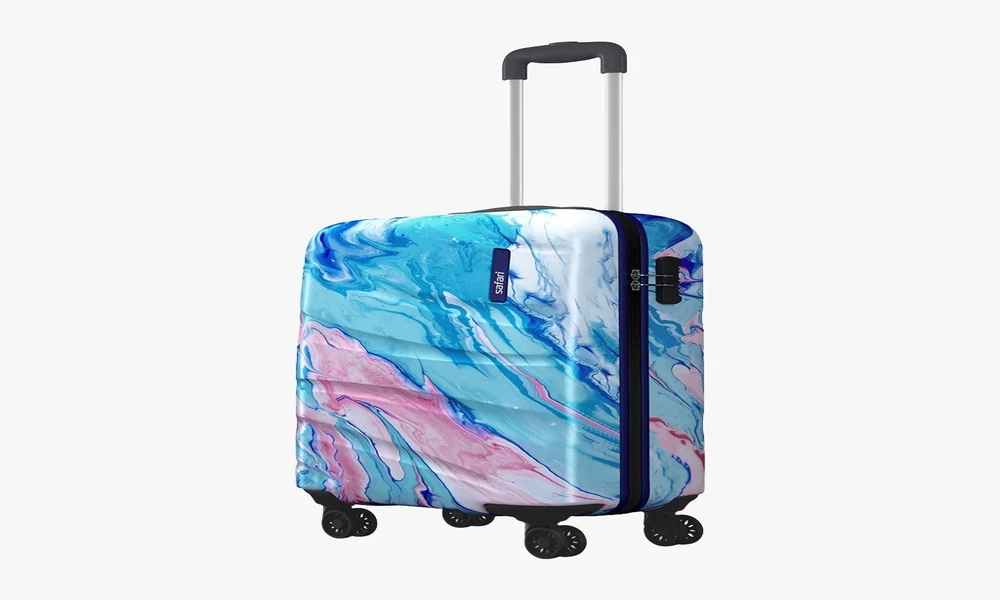
For anyone building a first set, a hard suitcase bag in cabin size is the most versatile starting point.
Which luggage bags are best for flights in India?
Direct answer: For flights, a hard-shell cabin trolley of up to 7 kg plus a small backpack covers trips of up to three days. For longer trips, add a medium checked suitcase that stays near IndiGo’s 15 kg domestic allowance. Spinner wheels and a TSA lock help on international routes.
Airline rules shape the right luggage bags more than any other factor. Under the BCAS one-hand-bag rule, you get one cabin bag and one personal item. Check-in allowances vary: IndiGo allows 15 kg domestic and up to 30 kg on many international routes.
The trolley bags you choose for flying should be light when empty, because the airline weighs the shell along with everything inside it.
Which luggage bags work best for train and road trips?
Direct answer: For train journeys, soft suitcases and duffels work best because they fit under berths and squeeze into luggage racks. For road trips, soft bags and duffels pack more efficiently into a car boot than rigid suitcases. Hard-shell bags are still useful when the car boot will be packed tightly with other luggage.
On Indian Railways, berth space is shared and stairs at stations are common. A medium soft trolley with strong wheels and a duffel you can carry on your shoulder is easier than one large hard case.
Scenario: A Delhi family of five travels to a wedding in Jaipur by Shatabdi Express, then by car to the venue. They take two medium soft trolleys for clothes, one garment bag for wedding outfits and a duffel for gifts. Everything fits under the seats and in the car boot. A single large hard suitcase would have blocked the aisle and needed two people to lift.
How do you build a luggage set that covers every trip?
Direct answer: Start with a cabin trolley, add a medium checked suitcase, and finish with a laptop or travel backpack. These three luggage bags cover business trips, weekend breaks, family holidays and most international travel. Add a large suitcase or duffel only if you regularly take long trips or travel for weddings and relocation.
- Buy the cabin trolley first. It’s the bag you’ll use most, for weekends and short flights.
- Add a medium suitcase. Choose 65-69 cm for week-long trips and the 15 kg domestic allowance.
- Pick a backpack. It works as your personal item on flights and as a day bag at your destination.
- Add a duffel for flexibility. It handles road trips, gym days and extra shopping on the way back.
- Consider a large case last. Buy one only if you travel abroad for long stays or carry wedding luggage often.
Most traveling bags last longer when you rotate them, so a small set ages better than a single bag used for everything.
What are the most common mistakes when buying luggage bags?
Direct answer: The most common mistakes are buying the biggest size available, ignoring empty weight, choosing cheap wheels and zips, and skipping the warranty. Many buyers also pick a colour that shows scuffs quickly. These mistakes lead to excess baggage fees, broken wheels after a few trips and bags that look worn within a year.
- Buying too big: A large bag on a 15 kg ticket is wasted space and a temptation to overpack.
- Ignoring empty weight: A heavy shell eats into your baggage allowance.
- Weak wheels: Wheels fail first, so look for double spinners and replaceable parts.
- No ID: Add a luggage tag with your phone number and a distinctive strap for quick belt pickup.
- Skipping the warranty: A longer warranty usually reflects better build quality.
Practical tip: Photograph your luggage bags and their contents before an international flight. If a bag is delayed, the photos make a claim with the airline much faster.
How should you care for luggage bags?
Direct answer: Wipe hard shells with a damp cloth, brush soft fabrics, and let bags dry fully after monsoon travel before storing them. Keep them in a cool, dry place with the zips closed. Check wheels and handles before each trip, so you catch problems at home rather than on a railway platform.
Humidity is the hidden risk in much of India. A bag stored damp can develop mould inside its lining within weeks. Leave a silica gel pouch inside during long storage, especially in coastal cities such as Mumbai, Chennai and Kochi.
How Samsonite can help
Samsonite has made luggage since 1910 and runs about 600 stores in India, according to Indian Retailer (December 2025). Its range spans cabin and checked trolleys, duffels, backpacks and garment bags, with dimensions and empty weight listed for each model. Store teams can help you match a bag to your usual trips rather than to a single holiday.
FAQs
1. Which luggage bag is best for international travel?
For international travel, a medium or large hard-shell suitcase with spinner wheels and a TSA-approved lock works best. Pair it with a cabin trolley and a backpack. Check your airline’s per-person allowance and the 23 kg limit per checked bag before you pack.
2. Are soft or hard luggage bags better?
Hard luggage protects fragile items and handles rain better, which makes it good for flights. Soft luggage is more flexible, has outer pockets and fits into tight spaces such as car boots and train berths. Many travellers own both and pick based on the trip.
3. What luggage do I need for a one-week trip?
For a one-week trip, a medium suitcase of about 65-69 cm plus a backpack is usually enough. If you’re flying domestic economy on IndiGo, keep the suitcase near the 15 kg check-in allowance. Pack versatile clothes and leave a little room for shopping.
4. How long do good luggage bags last?
Good-quality luggage bags used a few times a year can last seven to ten years. Wheels, handles and zips wear out first. Choosing models with replaceable wheels and a long manufacturer’s warranty helps your bags last longer and keeps repair costs low.
5. Is it worth buying a luggage set?
A luggage set is worth it if you travel several times a year in different ways, such as flights, trains and road trips. A cabin trolley, a medium suitcase and a backpack cover most needs. Buying matching pieces also makes your bags easier to spot on a baggage belt.
Conclusion
The right luggage bags depend on how you travel, not just where you go. Flights reward light, hard cabin trolleys; trains and road trips reward soft bags and duffels; and long or international trips call for a medium or large checked suitcase. Build a small set around those needs, and every trip becomes easier to pack for. A versatile travel bag such as a duffel fills the gaps.